
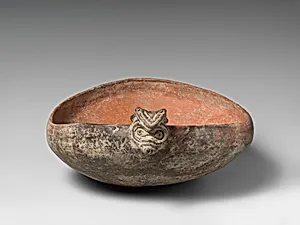
Bowl
Unknown Artist
13th–15th century
Medium
Ceramic
Dimensions
W. 15 in. (38.1 cm)
Classification
Ceramics-Containers
Culture
Taíno
Department
Arts of Africa, Oceania, and the Americas
Museum
Metropolitan Museum of Art, New York, NY
Credit
Purchase, Mary R. Morgan, Mary O'Boyle II and Mr. and Mrs. Frederick E. Landmann Gifts; The Michael C. Rockefeller Memorial Collection, Gift of Nelson A. Rockefeller and Bequest of Nelson A. Rockefeller, by exchange, and Gift of Nathan Cummings, by exchange, 1984
Accession Number
1984.201
Rights
Public Domain
Art Historical Context
This expansive ceramic bowl, crafted by an unknown Taíno artist the 13th and 15th centuries, exemplifies sophisticated pottery traditions of the Taíno, the indigenous inhabitants of the Caribbean islands like Hispaniola (modern-day Haiti and Dominican Republic), Puerto Rico, and Cuba. Measuring a generous 15 inches (38.1 cm) in width, its broad, open form suggests practical use as a container for food storage, serving, or communal rituals in daily life and ceremonies. The Taíno thrived in complex chiefdom societies during this late pre-Columbian era, just before Christopher Columbus's arrival in 1492, and their ceramics were vital to both utilitarian and spiritual practices. Taíno potters fashioned vessels like this one without a wheel, relying on coiling and hand-building techniques with local clays, often fired in open pits to achieve earthy tones. While specific decorative motifs on this bowl are not detailed, Taíno ceramics frequently featured incised patterns inspired by nature, mythology, or ancestral spirits (zemis), reflecting a worldview deeply connected to the cosmos and fertility. As a rare survivor from this period, it offers a tangible link to Taíno ingenuity and resilience, now preserved in the Metropolitan Museum of Art's Arts of Africa, Oceania, and the Americas department through generous gifts and exchanges in 1984. Visitors can appreciate how such objects illuminate a vibrant culture on the cusp of profound historical change.