
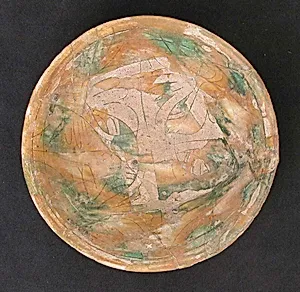
Bowl
Unknown Artist
9th–10th century
Medium
Earthenware; glazed
Dimensions
H. 2 3/4 in. (7 cm) Diam. 7 1/2 in. (19.1 cm) Wt. 14.4 oz. (408.3 g)
Classification
Ceramics
Department
Islamic Art
Museum
Metropolitan Museum of Art, New York, NY
Credit
Rogers Fund, 1933
Accession Number
33.175.49
Rights
Public Domain
Art Historical Context
This elegant earthenware bowl, dating to the 9th–10th century, exemplifies the refined ceramic artistry of the early Islamic world. Crafted during the Abbasid Caliphate's golden age, when Baghdad was a bustling hub of culture and trade, the bowl measures just 2¾ inches (7 cm) in height and 7½ inches (19.1 cm) in diameter, with a sturdy weight of 14.4 oz. (408.3 g). Its glazed surface—likely a vibrant turquoise or monochrome typical of the era—protected the fragile earthenware while adding a luxurious sheen, making everyday vessels like this both functional and beautiful. Glazed ceramics represented a technological leap in Islamic art, with potters mastering high-fire techniques to create durable, waterproof objects for dining, storage, and display. Produced in workshops across Mesopotamia and Persia, these bowls were ubiquitous in households, reflecting the era's emphasis on geometric patterns and subtle luster that foreshadowed later innovations like lusterware. Though the artist remains unknown, such anonymous works highlight the collaborative genius of medieval artisans. Today, this piece from the Metropolitan Museum of Art's Islamic Art collection (acquired through the Rogers Fund in 1933) invites us to appreciate how humble ceramics bridged art and daily life, carrying the splendor of a thriving civilization across centuries.