
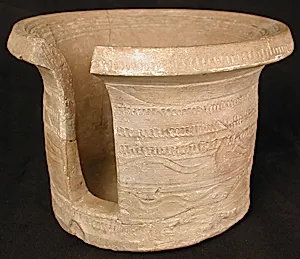
Bowl
Unknown Artist
13th century
Medium
Earthenware; incised decoration, unglazed
Dimensions
H. 5 1/8 in. (13 cm) Diam. 7 5/8 in. (19.3 cm) Th. 5/8 in. (1.6 cm)
Classification
Ceramics
Department
Islamic Art
Museum
Metropolitan Museum of Art, New York, NY
Credit
Rogers Fund, 1936
Accession Number
36.20.44
Rights
Public Domain
Art Historical Context
This unassuming yet elegant 13th-centuryware bowl from the Islamic exemplifies the everyday artistry of medieval ceramics. Standing just over 5 inches tall with a 7.5-inch diameter, its simple, unglazed form features incised decoration—a technique where designs are carved into the wet clay before firing, creating subtle textures and contrasts in the earth-toned surface. Such bowls were practical vessels for food and drink, blending utility with subtle aesthetic appeal. Produced during a golden age of Islamic craftsmanship, likely in regions like Persia or the Near East, this piece reflects the period's mastery of low-fired earthenware. Unglazed wares like this were durable for daily use and often adorned with geometric or floral motifs incised to evoke movement and depth without the sheen of glazes. The absence of glaze highlights the purity of the clay and the skill of the artisan, whose identity remains unknown, underscoring the collaborative nature of Islamic pottery workshops. Acquired through the Rogers Fund in 1936 and now housed in the Metropolitan Museum of Art's Islamic Art Department, this bowl invites us to appreciate the unsung beauty of functional objects. It reminds visitors how 13th-century artisans elevated ordinary life into art, bridging the domestic and the divine in Islamic culture.