
Bowl
Unknown Artist
9th century
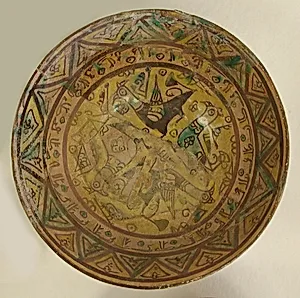
Medium
Earthenware; painted in black slip and polychrome pigments under transparent colorless glaze (buff ware)
Dimensions
H. 3 9/16 in. (9 cm) Diam. 8 1/4 in. (21 cm)
Classification
Ceramics
Department
Islamic Art
Museum
Metropolitan Museum of Art, New York, NY
Credit
Rogers Fund, 1939
Accession Number
39.40.80
Rights
Public Domain
Tags
Art Historical Context
This exquisite 9th-century earthenware bowl, hailing from the Islamic world during the Abbasid Caliphate's Golden Age, exemplifies the era's vibrant ceramic traditions. Measuring just 3 9/16 inches high and8 1/4 inches in diameter, it was crafted from buff ware—a pale, sandy clay common in Iraqi workshops like those in Basra. Acquired through the Rogers Fund in 1939, it now graces the Metropolitan Museum of Art's Art department, offering a window into daily life elevated by artistry. The bowl's surface is masterfully painted with black slip and polychrome pigments a transparent colorless glaze, a technique that marked an early innovation in Islamic pottery. This method allowed for bold, colorful designs to shine through the glossy finish, protecting the decoration while enhancing its luster. Bird motifs, a recurring theme in Islamic art symbolizing freedom and paradise gardens, likely adorn its interior, blending naturalistic elegance with abstract patterns typical of the period. Such vessels were not mere utensils but status symbols in prosperous households, reflecting the cultural flourishing of science, trade, and aesthetics under Abbasid rule. Though by an unknown artist, this bowl highlights how ceramics bridged utility and beauty, influencing later global traditions in glazed wares.