
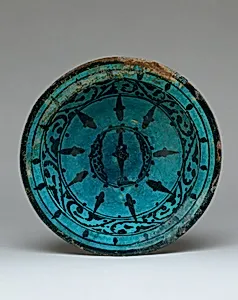
Bowl
Unknown Artist
12th century
Medium
Stonepaste; underglaze painted
Dimensions
H. 3 in. (7.6 cm) Diam. 9 3/4 in. (24.8 cm)
Classification
Ceramics
Department
Islamic Art
Museum
Metropolitan Museum of Art, New York, NY
Credit
H. O. Havemeyer Collection, Bequest of Horace Havemeyer, 1956
Accession Number
56.185.9
Rights
Public Domain
Art Historical Context
This graceful 12th-century bowl the Islamic world exemplifies the pinnacle of medieval ceramic innovation. Housed in the Metropolitan Museum of Art's Department of Islamic Art, it measures a modest 3 inches in height and nearly 10 inches in diameter, making it a perfect example of functional yet artistic tableware used in affluent households across the Seljuk Empire, which spanned Persia, Syria, and beyond during this era. Crafted from stonepaste—a sophisticated composite of quartz, clay, and glass frit—the bowl mimics the translucency and durability of coveted Chinese porcelain, a material unavailable to Islamic potters. The underglaze painting technique involved applying mineral pigments directly to the raw body before coating it with a transparent glaze and firing at high temperatures. This method produced vivid, enduring colors resistant to wear, highlighting the technical prowess of anonymous artisans in centers like Kashan or Raqqa. Acquired through the H.O. Havemeyer Collection and bequeathed in 1956, this unadorned yet elegant vessel invites us to appreciate the cultural zenith of Islamic ceramics, where everyday objects embodied aesthetic harmony and ingenuity.