
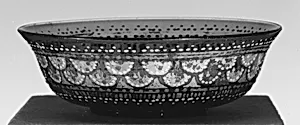
Bowl
Unknown Artist
ca. 1500
Medium
Transparent dark blue nonlead glass. Blown, enamaled, gilt.
Dimensions
H. 1 15/16 in. (4.9cm); Diam. of rim 6 1/8 in. (15.6cm)
Classification
Glass
Culture
Italian (Venice)
Department
Robert Lehman Collection
Museum
Metropolitan Museum of Art, New York, NY
Credit
Robert Lehman Collection, 1975
Accession Number
1975.1.1176
Rights
Public Domain
Art Historical Context
This exquisite shallow bowl, crafted around 1500 in Venice,, exemplifies the Renaissance mastery of glassmaking that made the city a global hub for luxury goods. Produced on the island of Murano, wheremakers honed secretive techniques under strict guild protections, this piece features transparent dark blue nonlead glass— prized for its vivid color and clarity without the brittleness of leaded alternatives. At just under 2 inches tall and 6 inches across the rim, its delicate scale suggests it was designed for serving confections, spices, or as a decorative table centerpiece in affluent homes. The bowl's artistry shines in its sophisticated production: blown into shape for thin, fluid walls, then meticulously enameled with colorful vitreous paints and adorned with gilding for a shimmering effect. These techniques, perfected by Venetian artisans, allowed for intricate designs that mimicked costly metalwork or enamels, blending functionality with opulence. Nonlead glass ensured durability and a pure, jewel-like translucency, reflecting Venice's role as a maritime trade powerhouse importing raw materials like silica and cobalt. Housed in the Metropolitan Museum of Art's Robert Lehman Collection since 1975, this anonymous masterpiece offers a glimpse into 16th-century Venetian innovation, where glass rivaled painting and sculpture in prestige. Visitors can appreciate how such objects fueled the era's taste for elegance and exoticism.