
Bowl
Unknown Artist
1780
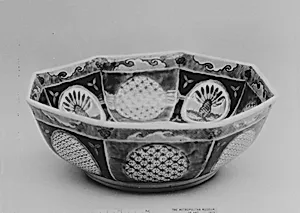
Medium
Porcelain decorated with enamels (Arita ware, Imari type)
Dimensions
H. 3 1/2 in. (8.9 cm); Diam. 10 1/4 in. (26 cm)
Classification
Ceramics
Culture & Period
Japan · Edo period (1615–1868)
Department
Asian Art
Museum
Metropolitan Museum of Art, New York, NY
Credit
Gift of Mrs. V. Everit Macy, 1923
Accession Number
23.225.153
Rights
Public Domain
Art Historical Context
This elegant porcelain bowl, crafted around 1780 during Japan's Edo period (16151868), exemplifies the of Arita ware, the vibrant Imari type. Produced in the Saga region of Kyushu, Arita kilns were renowned for their high-quality porcelain, fired at intense temperatures to achieve a translucent body. The bowl's shallow form—standing just 3½ inches high and spanning 10¼ inches in diameter—makes it ideal serving rice, soups, or communal dishes, reflecting everyday refinement in Japanese domestic life. Artistically, the piece showcases overglaze enamel decoration, a technique where colorful pigments like iron-red, cobalt blue, and gold were applied after initial glazing and fired at lower temperatures. This allowed for intricate motifs—often floral patterns, landscapes, or mythical scenes—that defined Imari's bold, export-oriented aesthetic. By the late 18th century, such wares were prized in European markets, blending Japanese ingenuity with global trade influences, symbolizing Edo-era prosperity and cultural exchange. A generous gift to the Metropolitan Museum of Art from Mrs. V. Everit Macy in 1923, this anonymous artist's creation invites visitors to appreciate the enduring allure of Japanese ceramics, where utility meets exquisite artistry.