
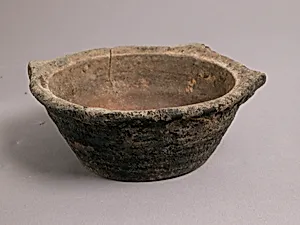
Bowl
Unknown Artist
4th–7th century
Medium
Earthenware
Dimensions
H: 2 5/16 in. (5.9 cm); Diameter: 5 7/8 in. (15 cm)
Classification
Ceramics
Culture
Coptic
Department
Medieval Art
Museum
Metropolitan Museum of Art, New York, NY
Credit
Rogers Fund, 1925
Accession Number
25.10.20.230
Rights
Public Domain
Tags
Art Historical Context
This unassuming earthenware bowl, by an unknown Coptic artisan between the 4th and 7th centuries, offers glimpse into the daily life of early Christian Egypt. Measuring just 2 5/16 inches high and 5 7/8 inches in diameter it exemplifies the practical ceramics produced in the Nile Valley during a transformative era. As Coptic culture emerged—blending ancient Egyptian traditions with Christianity—these vessels were essential household items, used for serving food or storing goods in monastic communities or rural homes. Coptic pottery like this bowl highlights the region's enduring ceramic techniques, likely wheel-thrown and fired at low temperatures to create durable, reddish earthenware. Though undecorated, its simple form reflects the utilitarian artistry of the time, prioritizing function amid social and religious upheaval, including the spread of monasticism and eventual Arab conquests. Such objects provide invaluable evidence of Coptic material culture, bridging pagan antiquity and medieval Christianity. Acquired through the Rogers Fund in 1925 and now housed in the Metropolitan Museum of Art's Medieval Art department, this bowl invites us to appreciate the quiet beauty of everyday artifacts that shaped history.