
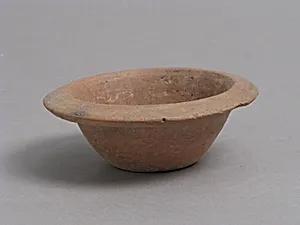
Bowl
Unknown Artist
4th–7th century
Medium
Earthenware
Dimensions
Overall: 1 3/8 x 3 5/8 in. (3.5 x 9.2 cm)
Classification
Ceramics
Culture
Coptic
Department
Medieval Art
Museum
Metropolitan Museum of Art, New York, NY
Credit
Rogers Fund, 1925
Accession Number
25.10.20.267
Rights
Public Domain
Tags
Art Historical Context
This delicate earthenware bowl, crafted by an unknown Coptic artisan between the 4th and 7th centuries, offers a glimpse into everyday life in early Christian Egypt. Measuring just 1 3/8 x 3 5/8 inches (3.5 x 9.2 cm), its modest size suggests it was used for personal purposes—perhaps holding spices, oils, or small portions of food in a household setting. Coptic culture, which flourished in Egypt after the spread of Christianity, blended ancient Egyptian traditions with Greco-Roman influences and emerging Christian motifs, making objects like this a bridge between pagan antiquity and the medieval world. Earthenware, a fired clay medium, was prized for its accessibility and durability in the Nile Valley's workshops. Coptic potters often employed simple wheel-throwing techniques, sometimes adding incised designs or slips for subtle decoration, though this bowl's unadorned form highlights the purity of function in utilitarian ceramics. As part of the Metropolitan Museum of Art's Medieval Art collection (acquired through the Rogers Fund in 1925), it exemplifies the understated artistry of Coptic craftsmanship, revealing how ordinary vessels carried profound cultural continuity amid religious transformation. Today, such artifacts remind us of the resilient communities that shaped Egypt's Christian heritage, inviting us to appreciate the beauty in the humble and the historical.