
Bowl
Unknown Artist
4th–7th century
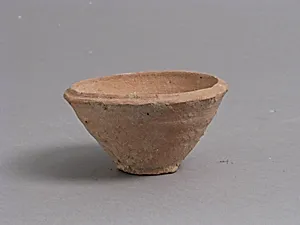
Medium
Earthenware
Dimensions
Overall: 1 11/16 x 3 1/8 in. (4.3 x 7.9 cm)
Classification
Ceramics
Culture
Coptic
Department
Medieval Art
Museum
Metropolitan Museum of Art, New York, NY
Credit
Rogers Fund, 1925
Accession Number
25.10.20.311
Rights
Public Domain
Tags
Art Historical Context
This delicate earthenware bowl, crafted by an unknown artist in Coptic Egypt between the 4th and 7th centuries, exemplifies the humble yet enduring artistry of early Christian North Africa. Measuring a modest 1 11/16 x 3 1/8 inches (4.3 x 7.9 cm), it was likely designed for everyday use—holding food, water, or offerings in a domestic setting. Its presence in the Metropolitan Museum of Art's Medieval Art department, acquired through the Rogers Fund in 1925, highlights its value as a window into a transitional era. Coptic culture, emerging as Christianity took root in Egypt after the Roman era, blended ancient Egyptian craftsmanship with new religious influences. Earthenware, a fired clay medium, was prized for its accessibility and durability, often wheel-thrown on pottery lathes for precise forms. These bowls reflect the continuity of ceramic traditions from pharaonic times into the early medieval period, serving both practical and possibly ritual purposes in monastic or household life. Though simple in scale, this bowl invites us to appreciate the anonymous makers whose skilled hands shaped the textures of daily existence, preserving cultural threads across centuries. A quiet survivor of history, it reminds us how ordinary objects can illuminate profound cultural shifts.