
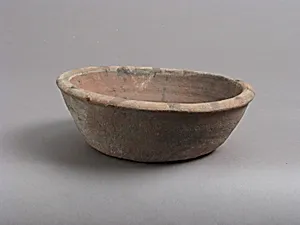
Bowl
Unknown Artist
4th–7th century
Medium
Earthenware
Dimensions
Overall: 1 7/8 x 5 1/4 in. (4.7 x 13.4 cm)
Classification
Ceramics
Culture
Coptic
Department
Medieval Art
Museum
Metropolitan Museum of Art, New York, NY
Credit
Rogers Fund, 1925
Accession Number
25.10.20.324
Rights
Public Domain
Tags
Art Historical Context
This unassuming earthenware bowl, by an unknown artist in Coptic Egypt between the 4th and 7th centuries, offers glimpse into the daily life of early Christian communities in late antique North Africa. Measuring just 1 7/8 x 5 1/4 inches (4.7 x 13.4 cm), its compact form suggests it was used for serving food or liquids in households, monasteries, or pilgrimage sites. Acquired through the Rogers Fund in 1925 and now housed in the Metropolitan Museum Art's Medieval Art Department it exemplifies the humble ceramics that bridged ancient Egyptian traditions with emerging Christian practices. Coptic culture, flourishing after Egypt's Christianization in the 4th century, blended Pharaonic, Greco-Roman, and Byzantine influences amid political shifts leading to the Arab conquest in the 7th century. Earthenware like this was fired at low temperatures, making it accessible and durable for everyday use, yet its survival highlights masterful potter's techniques—likely wheel-thrown and simply glazed or burnished for water resistance. As a ceramic artifact, it underscores the Copts' material world, where pottery served both practical and ritual purposes, reflecting resilience in a transformative era. Though modest, this bowl invites us to ponder the ordinary objects that shaped Coptic identity, preserving echoes of a vibrant, faith-filled society.