
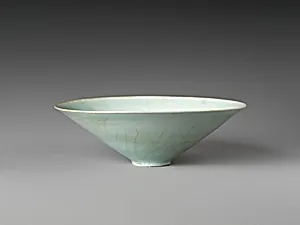
宋 景德鎮窯青白釉碗|Bowl
Unknown Artist
Medium
Porcelain with blue-white glaze (Jingdezhen Qingbai ware)
Dimensions
H. 2 in. (5.1 cm); Diam. 6 5/8 in. (16.8 cm); Diam. of foot 1 3/8 in. (3.5 cm)
Classification
Ceramics
Culture & Period
China · Song dynasty (960–1279)
Department
Asian Art
Museum
Metropolitan Museum of Art, New York, NY
Credit
Fletcher Fund, 1927
Accession Number
27.119.19
Rights
Public Domain
Art Historical Context
This delicate porcelain bowl, produced at the renowned Jingdezhen kilns China's Song dynasty (960–9), embodies the era's mastery of ceramics. Jingdezhen, in Jiangxi province, emerged as a pivotal center for high-fired porcelain, and this piece represents Qingbai ware—known for its signature "blue-white" glaze that evokes a soft, translucent glow, like pale jade or morning mist. The bowl's shallow form, standing just 2 inches (5.1 cm) tall with a 6⅝-inch (16.8 cm) diameter, features a subtle foot ring (1⅜ inches/3.5 cm across), showcasing the Song potters' skill in thin, even potting and precise control of the firing process. The glaze, applied over a refined kaolin body and fired in dragon kilns, achieves its luminous, crackled surface without added pigments, highlighting purity and restraint. In Song society, a golden age of arts and scholarship, such vessels served daily tea rituals yet were treasured for their aesthetic refinement, influencing later imperial porcelain. Acquired through the Fletcher Fund in 1927, this bowl graces the Metropolitan Museum of Art's Asian Art collection, offering visitors a tangible link to China's ceramic legacy.