
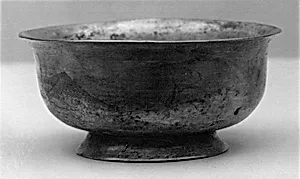
唐 銀碗|Bowl
Unknown Artist
Medium
Silver
Dimensions
H. 1 3/4 in. (4.4 cm); Diam. 3 3/4 in. (9.5 cm)
Classification
Metalwork
Culture & Period
China · Tang dynasty (618–907)
Department
Asian Art
Museum
Metropolitan Museum of Art, New York, NY
Credit
Rogers Fund, 1922
Accession Number
22.79.1
Rights
Public Domain
Art Historical Context
This delicate silver bowl hails from China's Tang dynasty (618–907 CE), a golden age of cultural flourishing, economic prosperity, and international exchange along the Silk Road. Crafted by an unknown artisan, it exemplifies the era's masterful metalwork, produced for the elite in urban centers like Chang'an, the cosmopolitan capital. With modest dimensions—1 3/4 inches high and 3 3/4 inches in diameter—this vessel likely served as a luxurious personal item, perhaps for cosmetics, spices, or small offerings, reflecting the Tang court's refined tastes. Silver was a prized medium in Tang China, often rivaling gold in prestige due to its luster and workability. Artisans employed sophisticated techniques like hammering thin sheets into shape, polishing to a mirror finish, and possibly subtle chasing or repoussé for decoration, showcasing advanced metallurgy honed over centuries. Such bowls highlight the dynasty's technical innovation and aesthetic elegance, blending functionality with artistry. Acquired through the Rogers Fund in 1922 and now housed in the Metropolitan Museum of Art's Asian Art Department, this bowl offers a tangible glimpse into Tang opulence. Imagine it gleaming on a noble's vanity, a testament to an era when China dazzled the world.