
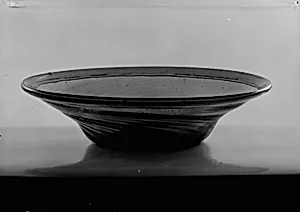
Bowl
Unknown Artist
1800–1830
Medium
Blown pattern-molded lead glass
Dimensions
H. 2 7/8 in. (7.3 cm); Diam. 8 1/8 in. (20.6 cm)
Classification
Bowl
Culture
American
Department
The American Wing
Museum
Metropolitan Museum of Art, New York, NY
Credit
Rogers Fund, 1942
Accession Number
42.20.3
Rights
Public Domain
Art Historical Context
This elegant bowl, crafted by an unknown American artist between 1800 and 1830, exemplifies the ingenuity of early 19th-century glassmaking in the United States. Made of blown pattern-molded lead glass it measures just 2⅞ inches high and 8⅛ inches in diameter, creating a shallow, wide form ideal for serving fruits, sweets, or punch. The technique involved gathering molten glass on a blowpipe, inserting it into a patterned mold to imprint textures like ribs or swirls, and then reheating and expanding it for clarity and brilliance. Lead glass, prized for its refractive sparkle akin to European crystal, elevated everyday objects into affordable luxuries for American households. Housed in The American Wing of The Metropolitan Museum of Art—acquired through the Rogers Fund in 1942—this bowl reflects the rapid growth of domestic glass production during the early republic. Factories in regions like New England and the Mid-Atlantic adapted European methods to local tastes, blending functionality with decorative flair. Such pieces highlight America's emerging industrial prowess and cultural aspirations, bridging colonial simplicity with neoclassical refinement. Visitors will appreciate its subtle glow under gallery lights, a testament to skilled artisans whose anonymous works shaped daily life in a young nation.