
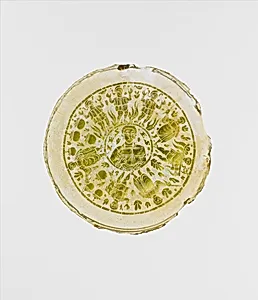
Bowl Base with Miracle Scenes
Unknown Artist
ca. 350–400
Medium
Glass, gold leaf
Dimensions
Overall: Diam. 3/16 x 4 3/16 in. (0.5 x 10.7 cm)
Classification
Glass-Gold glass
Culture
Roman or Byzantine
Department
Medieval Art
Museum
Metropolitan Museum of Art, New York, NY
Credit
Rogers Fund, 1916
Accession Number
16.174.2
Rights
Public Domain
Tags
Art Historical Context
This delicate *Bowl Base with Miracle*, crafted around 350–400 CE, the luxurious gold-glass technique of the late Roman or early Byzantine world. Made by sandwiching shimmering gold leaf between two layers of glass, the small disc—measuring just 0.5 x 10.7 cm—was likely the base of an intimate drinking vessel. The gold foil, etched with scenes of miracles featuring male figures, creates a radiant, illuminated effect when held to light, evoking divine glow in everyday use. Dating to the 4th century, this artifact captures a pivotal era when Christianity was ascending in the Roman Empire, post-Constantine. Gold glass objects like this often depicted biblical miracles, saints, or Christ, serving as personal talismans or memorials for the faithful elite. Their fragility and opulence highlight the fusion of pagan glassworking traditions with emerging Christian iconography, bridging classical antiquity and the medieval period. Acquired through the Rogers Fund in 1916 and housed in The Metropolitan Museum of Art's Medieval Art department, this rare survivor offers a glimpse into private devotion. Imagine sipping wine through such a vessel, miracles sparkling beneath— a testament to art's power to sanctify the mundane.