
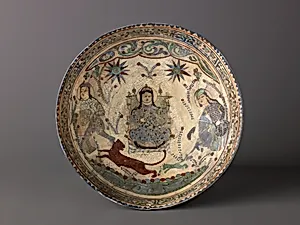
Bowl, Minai'i ("enameled") ware
Unknown Artist
late 12th–early 13th century
Medium
Minai'i ware. Fritware, stain-and overglaze-painted, and gilded.
Dimensions
Diameter: 8 1/4 in. (21 cm.)
Classification
Ceramics-Pottery
Culture
Iranian
Department
Robert Lehman Collection
Museum
Metropolitan Museum of Art, New York, NY
Credit
Robert Lehman Collection, 1975
Accession Number
1975.1.1639
Rights
Public Domain
Tags
Art Historical Context
This exquisite bowl exemplifies *minai'i* ("enameled") ware, pinnacle of Iranian ceramic artistry from the late 12 to early 13th. Crafted during the Seljuk in centers like Kashan, it reflects the opulence of Persian court culture, where pottery served as luxury tableware for the elite. Measuring 8¼ inches in diameter, its fritware body—a quartz-based composite fired to mimic porcelain's translucency—provided a perfect canvas for vibrant storytelling. The bowl's surface bursts with intricate overglaze enamel painting, underglaze stains in cobalt blue, and delicate gilding, all low-fired to preserve jewel-like colors. Scenes likely feature lively animals and human figures—men in dynamic poses amid foliage or hunts—echoing the narrative miniature style of Persian manuscripts. This multi-stage technique, rare and labor-intensive, made *minai'i* ware a short-lived innovation (ca. 1180–1220), prized for its painterly freedom and gold accents that shimmered by candlelight. Housed in the Metropolitan Museum of Art's Robert Lehman Collection since 1975, this anonymous masterpiece highlights Iran's mastery of ceramics, bridging pottery and painting traditions. Visitors, gaze closely: each figure whispers tales of a golden age long past.