
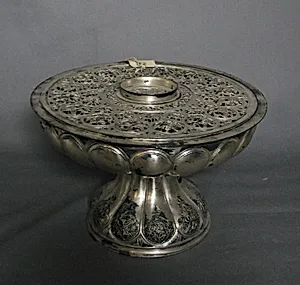
Bowl or basin
Unknown Artist
19th century, after 16th century original
Medium
Silver on base metal
Dimensions
Overall (confirmed): 8 7/8 × 12 5/8 × 12 5/8 in. (22.5 × 32.1 × 32.1 cm)
Classification
Metalwork-Electrotype
Culture
British, after Russian original
Department
European Sculpture and Decorative Arts
Museum
Metropolitan Museum of Art, New York, NY
Credit
Gift of Henry G. Marquand, 1883
Accession Number
83.18.80a, b
Rights
Public Domain
Art Historical Context
This elegant bowl or basin, a 19th-century British electro reproduction of a 16-century Russian original, captures opulence of Renaissance-era metalwork. Crafted in silver over base metal, it measures a substantial 8⅞ × 12⅝ × 12⅝ inches, making it a striking centerpiece for any table or display. Donated to the Metropolitan Museum of Art 1883 by Henry G. Marquand, it in the European Sculpture andative Arts department, highlighting the Met's commitment to preserving cultural treasures through innovative copying techniques. Electrotyping, a pioneering 19th-century process, used electrolysis to create precise replicas of precious originals, allowing museums to share rare artifacts without risking damage. This British-made copy after a Russian prototype reflects the era's fascination with historical revival and international exchange, blending Eastern European craftsmanship with Western industrial ingenuity. The silver surface would have gleamed under candlelight, evoking the grandeur of tsarist courts. As a testament to metalwork's enduring allure, this piece invites visitors to appreciate how technology democratized art, bridging centuries and cultures in the decorative arts tradition.