
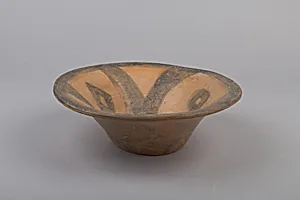
Bowl (Wan)
Unknown Artist
2300–2000 BCE
Medium
Earthenware with pigment
Dimensions
Diam. 9 3/4 in. (24.8 cm)
Classification
Ceramics
Culture & Period
China · Neolithic period, Majiayao culture, Machang type
Department
Asian Art
Museum
Metropolitan Museum of Art, New York, NY
Credit
Charlotte C. and John C. Weber Collection, Gift of Charlotte C. and John C. Weber, 1994
Accession Number
1994.605.129
Rights
Public Domain
Art Historical Context
This delicate bowl, known as a *wan*, originates from China's Neolithic period (2300–2000 BCE), specifically the Majiay culture's Machang type the northwest region. Crafted by an artist, it reflects the sophisticated pottery traditions of one of China's earliest farming communities, where vessels like this served both practical daily needs and possibly ritual purposes. Standing at a modest diameter of 9 3/4 inches (24.8 cm), its simple form highlights the ingenuity of prehistoric artisans who shaped earthenware by hand on slow wheels or coils. The medium—earthenware fired at low temperatures and adorned with pigment—marks a key artistic achievement. The applied pigments, likely creating bold patterns typical of Majiayao ceramics, demonstrate early mastery of color and decoration on pottery surfaces. This technique not only enhanced functionality but also expressed cultural identity, with motifs often evoking the natural world or geometric abstractions that bridged utility and symbolism. Housed in the Metropolitan Museum of Art's Asian Art Department as part of the Charlotte C. and John C. Weber Collection (gift, 1994), this bowl offers a tangible window into Neolithic China's vibrant material culture, underscoring the Majiayao people's role in laying foundations for later Chinese ceramic arts.