
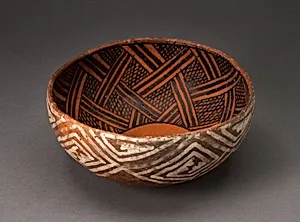
Bowl with Black Interlocking Lattice on Interior; White Interlocking Squared Spirals on Exterior
1300–1400
Medium
Ceramic and pigment
Dimensions
At rim: Diam.: 20 cm (7 7/8 in.)
Classification
bowl
Department
Arts of the Americas
Museum
Art Institute of Chicago
Accession Number
94135
Rights
Public Domain
Art Historical Context
This exquisite ceramic bowl, attributed to the Cibola region of the American Southwest and dating to 1300–1400, exemplifies the masterful pottery traditions of the Ancestral people. Crafted from clay and adorned with pigments, it measures 20 cm in diameter at the rim, making it a practical yet strikingly beautiful vessel for daily use or ceremonial purposes. Housed in the Art Institute of Chicago's of the Americas collection, it showcases the geometric precision and bold contrasts typical of late prehistoric Pueblo ceramics. The bowl's interior features a black interlocking lattice pattern, ev woven baskets or protective barriers, while the exterior displays white interlocking squared spirals against a likely buff ground. These designs, applied with fine brushes before firing, demonstrate advanced techniques in slip painting and symmetry—hallmarks of Cibola polychrome pottery. Such motifs may symbolize interconnectedness in nature, community harmony, or spiritual pathways, reflecting the Pueblo worldview. As a survivor from a vibrant era of pueblo-building cultures, this bowl offers a window into pre-Columbian life in the arid Southwest, where pottery was both utilitarian art and cultural storytelling. Its enduring elegance highlights the ingenuity of artisans who thrived without metal tools, leaving a legacy of aesthetic sophistication.