
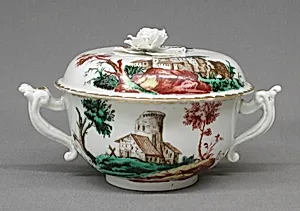
Bowl with cover
Medium
Soft-paste porcelain
Dimensions
Overall (confirmed): 3 5/8 × 6 1/4 × 4 3/4 in. (9.2 × 15.9 × 12.1 cm)
Classification
Ceramics-Porcelain
Culture
Italian, Nove
Department
European Sculpture and Decorative Arts
Museum
Metropolitan Museum of Art, New York, NY
Credit
Rogers Fund, 1906
Accession Number
06.377a, b
Rights
Public Domain
Tags
Art Historical Context
This elegant covered bowl, crafted by the Le Nove Porcelain Manufactory in northern Italy between 1765 and 1770, exemplifies the refined taste of eighteenth-century European ceramics. Produced in soft-paste porcelain—a material developed in Europe as an alternative to the highly prized hard-paste porcelain from China and Meissen—the piece showcases the factory’s skill in creating delicate, luminous surfaces suited to intricate painted decoration. Its compact form, just over three inches tall, suggests it was designed for intimate use, perhaps as a sugar bowl or small serving vessel on an aristocratic table. The bowl’s painted landscape, featuring houses nestled among trees, reflects the period’s fascination with idyllic rural scenes inspired by contemporary prints and drawings. Le Nove artists often drew from Venetian and French decorative traditions, blending playful Rococo sensibility with a distinctly Italian warmth in color and composition. Such motifs invited viewers to imagine serene countryside escapes, popular among collectors during the Enlightenment. As part of the Metropolitan Museum’s collection of European decorative arts, this work highlights Italy’s important role in the spread of porcelain technology and artistry across the continent. Its acquisition through the Rogers Fund in 1906 underscores the enduring appeal of these finely crafted objects.