
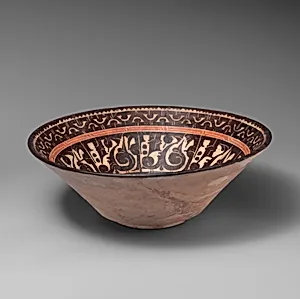
Bowl with Pseudo-Inscriptional Design
Unknown Artist
10th century
Medium
Earthenware; white slip with polychrome slip decoration under transparent glaze
Dimensions
H. 4 3/16 in. (10.6 cm) Diam. of rim: 11 13/16 in. (30 cm)
Classification
Ceramics
Department
Islamic Art
Museum
Metropolitan Museum of Art, New York, NY
Credit
Purchase, Rogers Fund, Lewis and Gemma Hall Gift, Louis E. and Theresa S. Seley Purchase Fund for Islamic Art, and Harvey B. Plotnick Gift, 2003
Accession Number
2003.415
Rights
Public Domain
Art Historical Context
This elegant 10th-century earthen bowl from the Islamic world showcases the ingenuity of medieval ceramicists, who transformed everyday vessels into stunning decorative objects. Housed in the Metropolitan Museum of Art's of Islamic Art, it just over 4 inches tall with a wide 11 13/16-inch rim, perfect for serving communal meals or displaying fruit in bustling households across regions like Iraq or Iran. The bowl's surface gleams with a white slip base, adorned in vibrant polychrome slip decoration—layers of colored clay slips applied before firing—sealed under a transparent glaze for a lustrous finish. This technique, pioneered in the 9th-10th centuries, allowed artisans to mimic costly lusterware while using affordable materials, creating bold patterns that pop against the creamy ground. The "pseudo-inscriptional" design features swirling, calligraphic-like motifs that evoke Arabic script without forming actual words, a playful convention in Islamic art to add rhythm and mystery without religious specificity. Such bowls highlight the cultural flourishing of the Abbasid era, blending utility with artistry and reflecting a sophisticated aesthetic that influenced ceramics from Spain to China. Acquired in 2003 through generous gifts, it invites us to appreciate the anonymous master's skill in evoking luxury through illusion.