
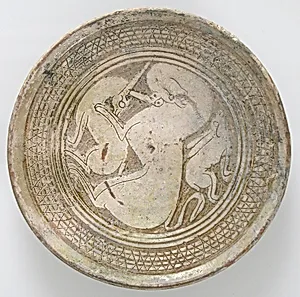
Bowl with Three Animals
Unknown Artist
1100–1300
Medium
Engraved cut-slipware
Dimensions
Overall: 1 13/16 x 8 3/4 in. (4.6 x 22.2 cm)
Classification
Ceramics
Culture
Byzantine
Department
Medieval Art
Museum
Metropolitan Museum of Art, New York, NY
Credit
Rogers Fund, 1971
Accession Number
1971.147.2
Rights
Public Domain
Tags
Art Historical Context
This delicate *Bowl with Three Animals*, crafted by an unknown artist between 1100 and 1300, exemplifies the refined ceramics of the Byzantine Empire during its Middle period. Housed in the Metropolitan Museum of Art's Medieval Art department (acquired through the Rogers Fund in 1971), this small vessel—measuring just 1 13/16 x 8 3/4 inches—served both practical and decorative purposes in Byzantine households, blending everyday utility with artistic flair. The bowl's standout feature is its *engraved cut-slipware* technique, a sophisticated method where a layer of contrasting slip (liquid clay) was applied over the base clay, then incised with fine tools to reveal the underlying color. This created bold, dynamic motifs of three animals parading around the interior, showcasing the artisan's precision and the era's mastery of ceramic decoration. Such techniques, influenced by Eastern Mediterranean traditions, highlight Byzantine potters' innovation in producing affordable yet visually striking wares. Culturally, animal imagery in Byzantine ceramics often evoked the natural world and symbolic vitality, reflecting the empire's rich fusion of Christian, classical, and Islamic artistic influences. Though modest in scale, this bowl offers a window into medieval life, where even tableware carried artistic weight. Visitors, admire how its enduring elegance bridges the gap between craft and high art!