
Box
1765–66
Medium
Gold, enamel
Dimensions
1 1/2 x 3 x 1 7/16 in. (3.8 x 7.6 x 3.7cm)
Classification
Metalwork-Gold and Platinum
Culture
French, Paris
Department
European Sculpture and Decorative Arts
Museum
Metropolitan Museum of Art, New York, NY
Credit
Bequest of Catherine D. Wentworth, 1948
Accession Number
48.187.442
Rights
Public Domain
Tags
Art Historical Context
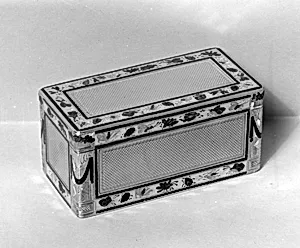
Step into the opulent world of 18th-century French decorative arts with Jean-Joseph Barrière's exquisite *Box* (1765–66), a petite masterpiece measuring just 1 1/2 x 3 x 1 7/16 inches. Crafted in Paris during the lavish Rococo era, this gold and enamel treasure exemplifies the height of luxury metalwork, likely a snuffbox or bonbonnière favored by the aristocracy. Barrière, a goldsmith, was celebrated for his intricate designs that captured nature's whimsy on a miniature scale. The box's gold body, adorned with translucent and painted enamels, showcases Barrière's virtuosic technique. Fine chasing and engraving on the gold provide a textured ground for the enamel, fired in layers to achieve vibrant, jewel-like colors and depth. Delicate insect motifs—evident from its thematic tags—bring a playful naturalism to the surface, reflecting Rococo's love for organic forms, asymmetry, and lighthearted elegance amid Louis XV's courtly splendor. Housed in The Metropolitan Museum of Art's European Sculpture and Decorative Arts department, this piece, bequeathed by Catherine D. Wentworth in 1948, highlights Paris's dominance in goldsmithing. It invites us to marvel at the era's fusion of technical precision and artistic delight, a tiny portal to Versailles' gilded refinement.