
Box
Unknown Artist
1830–70
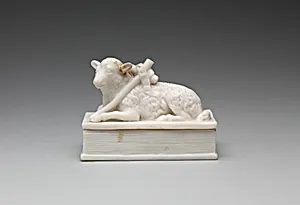
Medium
Parian porcelain
Dimensions
2 1/2 x 1 7/8 x 3 3/8 in. (6.4 x 4.8 x 8.6 cm)
Classification
Box
Culture
American
Department
The American Wing
Museum
Metropolitan Museum of Art, New York, NY
Credit
Gift of Dr. Charles W. Green, 1947
Accession Number
47.90.32a, b
Rights
Public Domain
Tags
Art Historical Context
This delicate box, crafted from Parian porcelain between 1830 and 1870, exemplifies the refined decorative arts of mid-nineteenth-century America. Measuring just over three inches wide, the piece features a smooth, matte surface characteristic of Parian ware, which was prized for its ability to mimic the look of fine marble at a more accessible cost. The presence of lambs as decorative motifs suggests a pastoral theme, evoking innocence and rural simplicity that resonated with Victorian-era tastes. Parian porcelain originated in England but found enthusiastic adoption in American workshops, where it was used for small functional objects like trinket boxes and desk accessories. As part of the Metropolitan Museum’s American Wing, this example highlights the growing domestic production of luxury goods during a period of industrial expansion and cultural refinement. Its compact scale and charming subject matter made it ideal for personal use or gifting, reflecting the era’s blend of utility and sentiment. Donated in 1947 by Dr. Charles W. Green, the box offers a window into everyday elegance in American homes of the time. Though the artist remains unknown, the work demonstrates skilled molding techniques that captured soft, lifelike details in the lambs, underscoring the technical achievements of early American ceramic artists.