
Box in the form of a cat
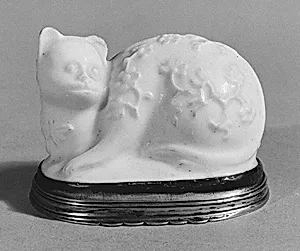
Medium
Soft-paste porcelain, silver
Dimensions
2 × 2 3/4 in. (5.1 × 7 cm)
Classification
Ceramics-Porcelain
Culture
French, Saint-Cloud with Paris mounts
Department
European Sculpture and Decorative Arts
Museum
Metropolitan Museum of Art, New York, NY
Credit
The Lesley and Emma Sheafer Collection, Bequest of Emma A. Sheafer, 1973
Accession Number
1974.356.550
Rights
Public Domain
Tags
Art Historical Context
Nestled in the whimsical world of 18th-century French decorative, *Box in the Form of a Cat* (ca. 1738) exemplifies the playful ingenuity of the Saint-Cloud factory. Crafted by Luc Bouillerot, a skilled artisan at this pioneering manufactory, the petite box—measuring just 2 × 2 3/4 inches—takes the form of a crouching cat, its soft-paste porcelain body vividly modeled and painted with lifelike fur and alert features. Delicate silver mounts from Paris add a touch of opulent gleam, transforming it into a coveted trinket or snuffbox for the elite. Saint-Cloud, established around 1690 near Paris, was among France's earliest porcelain producers, renowned for soft-paste porcelain—a glassy, translucent material fired at lower temperatures than true hard-paste from China or Meissen. This technique allowed for intricate molding and colorful enameling, capturing the Rococo era's delight in nature-inspired motifs and asymmetry. By the 1730s, under royal patronage, Saint-Cloud pieces like this cat box blended technical innovation with charm, rivaling luxury imports. Cats held cultural allure in 18th-century France as symbols of mischief and grace, often featured in porcelain novelties for aristocratic tables. Gifted through The Lesley and Emma Sheafer Collection at The Metropolitan Museum of Art, this enchanting object invites visitors to appreciate how everyday whimsy elevated porcelain to high art.
About the Artist
Luc Bouillerot|Saint-Cloud factory ( |French) · 1690 |1693 –1748 |1766
master 1720, died between 1742–48|French, mid-1690s–1766