
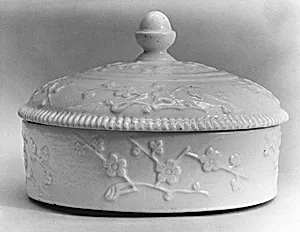
Box with cover
ca. 1720–40
Medium
Soft-paste porcelain
Dimensions
Overall (with cover): 4 1/16 × 5 15/16 in. (10.3 × 15.1 cm); Diameter (body): 5 3/4 in. (14.6 cm)
Classification
Ceramics-Porcelain
Culture
French, Saint-Cloud
Department
European Sculpture and Decorative Arts
Museum
Metropolitan Museum of Art, New York, NY
Credit
Gift of R. Thornton Wilson, in memory of Florence Ellsworth Wilson, 1954
Accession Number
54.147.12a, b
Rights
Public Domain
Tags
Art Historical Context
This delicate *Box with Cover* from the Saint-Cloud factory, crafted around 1720–40, exemplifies early French porcelain artistry. Made of soft-paste porcelain—a European innovation blending clay, glass frit, and white ash for a translucent, ivory-like glow—this petite lidded container measures just over 4 inches tall and nearly 6 inches wide. Adorned with floral motifs it served as a luxurious trinket or snuff box, reflecting the era's fascination with refined, intimate objects. Saint-Cloud, established in the late 17th century near Paris, was among France's pioneering porcelain manufactories, producing soft-paste wares from the 1690s until 1766. During the Regency and early Louis XV periods, these pieces emulated prized Chinese and Meissen imports, fueling a boom in domestic luxury goods. The factory's kilns achieved vibrant overglaze enameling and gilding, techniques that brought blossoms to life in delicate blues, pinks, and golds, capturing the budding Rococo taste for nature's whimsy. Housed in The Metropolitan Museum of Art's European Sculpture and Decorative Arts department, this box—gifted in 1954—highlights porcelain's role in elevating everyday elegance to high art. Visitors will appreciate its tactile charm, a testament to French ingenuity in rivaling Eastern porcelain traditions.
About the Artist
Saint-Cloud factory · 1693–1766
The Saint-Cloud porcelain factory, situated on the Seine in the town of Saint-Cloud near Paris, revolutionized European ceramics as the first to manufacture soft-paste porcelain commercially, beginning in 1693. Originally established around 1664-1666 as a faience workshop, it shifted to porcelain under Pierre Chicaneau, a potter whose experiments yielded a frit-based paste with a warm yellowish or...