
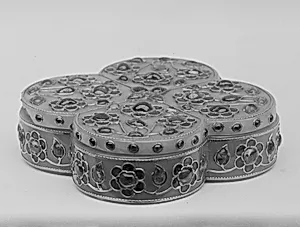
Box with Cover
Unknown Artist
17th century
Medium
Nephrite, gray with faint greenish tint
Dimensions
H. 7/8 in. (2.3 cm); W. 2 11/16 in. (6.8 cm); D. 2 11/16 in. (6.8 cm)
Classification
Jade
Culture & Period
India · Mughal period
Department
Asian Art
Museum
Metropolitan Museum of Art, New York, NY
Credit
Gift of Heber R. Bishop, 1902
Accession Number
02.18.776a, b
Rights
Public Domain
Art Historical Context
This exquisite "Box with Cover," in the 17th century during India's Mughal period, exemplifies the era's mastery of luxury materials. Fashioned from nephrite—a durable gray jade with a faint greenish tint—the small rectangular box measures just 7/8 inch high and about 2 11/16 inches wide and deep, making it a perfect fit for a pocket or jewelry case. Its compact form highlights the Mughals' appreciation for refined, portable treasures, likely used to hold precious spices, gems, or among the elite. In the opulent Mughal court, jade held profound cultural significance as a symbol of imperial power and refinement. Nephrite, often sourced from distant regions like Central Asia, was meticulously carved by skilled artisans into functional yet artistic objects. Though the artist remains unknown, the choice of this stone underscores its rarity and revered qualities: its toughness allowed for intricate detailing, while its subtle hue evoked serenity and prestige. Such boxes were status symbols, reflecting the empire's cosmopolitan trade networks under emperors like Shah Jahan. Today, this delicate piece graces the Metropolitan Museum of Art's Asian Art Department, a gift from Heber R. Bishop in 1902. Pause to admire its understated elegance—a testament to Mughal ingenuity that invites us to treasure the artistry in everyday luxury.