
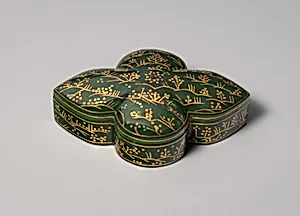
莫臥兒王朝 鑲金嵌寶碧玉花葉形盒|Box with cover
Unknown Artist
18th–19th century
Medium
Jade (nephrite) with gold and semiprecious stone inlays
Dimensions
H. 1 1/8 in. (2.9 cm); W. 3 11/16 in. (9.4 cm); D. 2 9/16 in. (6.5 cm)
Classification
Jade
Culture & Period
India · Mughal period (1526–1858)
Department
Asian Art
Museum
Metropolitan Museum of Art, New York, NY
Credit
Gift of Heber R. Bishop, 1902
Accession Number
02.18.786a, b
Rights
Public Domain
Art Historical Context
This exquisite jade box with cover, shaped like a stylized flower leaf, hails from the Mughal Empire in India during the 18th–19th century, a golden age of opulent craftsmanship under the Mughal period (1526–1858). Crafted from nephrite jade—a tough, translucent green stone prized for its durability and luster—the box measures just 1⅛ inches high and about3⅔ inches wide, for intimate treasures like jewelry spices, or betel nuts. Its petite scale belies its grandeur, gifted to the Metropolitan Museum of Art 1902 by Heber R. Bishop. Mughal artisans excelled in hardstone carving, transforming imported nephrite (likely from Central Asia) into delicate forms through meticulous polishing and intricate inlays of gold and semiprecious stones. This technique, akin to the empire's famed pietra dura work in architecture like the Taj Mahal, created floral motifs that shimmered with jewel-like precision, symbolizing nature's abundance and imperial refinement. Such boxes embodied Mughal luxury and status, often commissioned for courtly elites. This piece reflects the empire's fusion of Persian, Indian, and Islamic influences, showcasing technical virtuosity that continues to captivate today in the Met's Asian Art collection.