
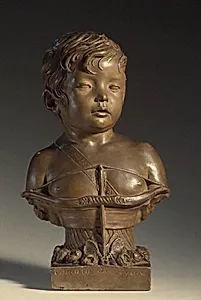
Boy as Cupid
ca. 1802–4
Medium
Plaster, painted to resemble terracotta
Dimensions
Height: 18 in. (45.7 cm)
Classification
Sculpture
Culture
French, Lyons
Department
European Sculpture and Decorative Arts
Museum
Metropolitan Museum of Art, New York, NY
Credit
Purchase, Bequest of Mary S. Shattuck and Gift of Rev. A.D. Pell, by exchange, and Rogers Fund, 1976
Accession Number
1976.242
Rights
Public Domain
Tags
Art Historical Context
In the early 19th century, sculptor Joseph Chinard captured playful spirit of classical mythology in *Boy as Cup* (ca. 1802–4). Hailing from Lyons, Chinard was a master of Neoclassicism, blending the idealized forms of ancient Greco-Roman art with the refined elegance of post-Revolutionary France. This charming 18-inch plaster sculpture, painted to mimic the warm glow of terracotta, depicts youthful Cupid—god of love—poised with his iconic bow and arrow, surrounded by fluttering butterflies that evoke themes of desire and transformation. Chinard's choice of medium was both practical and artistic: plaster allowed for detailed modeling in workshops, while the terracotta-like finish lent an antique authenticity, popular during the Napoleonic era's revival of classical motifs. Created amid France's cultural shift from Revolution to Empire, the work reflects Lyons' vibrant sculptural tradition, where Chinard produced portrait busts and allegorical figures for elite patrons. Today, housed in the Metropolitan Museum of Art's European Sculpture and Decorative Arts department, *Boy as Cupid* delights visitors with its mischievous energy. Notice the delicate butterfly wings and taut bowstring—subtle nods to love's fleeting, enchanting power. A testament to Chinard's skill, it bridges everyday whimsy and timeless myth.