
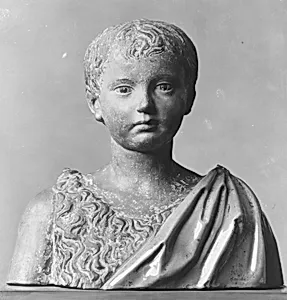
Boy Saint John
15th–16th century
Medium
Terracotta, enamelled and painted
Dimensions
Height: 14 3/8 in. (36.5 cm)
Classification
Sculpture
Culture
Italian, Florence
Department
European Sculpture and Decorative Arts
Museum
Metropolitan Museum of Art, New York, NY
Credit
Gift of J. Pierpont Morgan, 1917
Accession Number
17.190.1408
Rights
Public Domain
Tags
Art Historical Context
In the heart of Renaissance Florence, Giovanni della Robbia crafted *Boy Saint John* during the late 15th or early 16th century, his family's renowned workshop tradition. The Della Robbias, led by Luca, Andrea, and Giovanni, revolutionized sculpture with their signature tin-glazed terracotta, blending the durability of clay with the luminosity of colorful enamels. This small-scale figure (just 14⅜ inches tall) depicts the young Saint John the Baptist, Florence's patron saint, symbolizing innocence, prophecy, and devotion—a popular motif for private chapels and homes. The artwork's medium is key to its artistic significance: terracotta is modeled, fired, then coated in vibrant enamel glazes and subtle paints, creating a jewel-like sheen that mimics precious metals while resisting weathering. This technique allowed for mass production of affordable yet exquisite religious art, democratizing beauty during the Renaissance. Giovanni's refined modeling captures the boy's tender gaze and delicate features, evoking spiritual purity. Today, this enchanting sculpture graces the Metropolitan Museum of Art, a gift from J. Pierpont Morgan in 1917. It invites visitors to ponder Florence's devout culture, where art bridged the earthly and divine.