
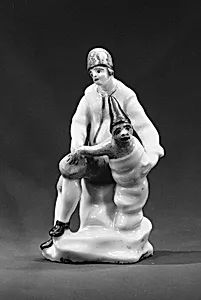
Boy with Monkey
ca. 1755–59
Medium
Soft-paste porcelain
Dimensions
Height: 3 7/16 in. (8.7 cm)
Classification
Ceramics-Porcelain
Culture
Italian, Naples (Capodimonte)
Department
European Sculpture and Decorative Arts
Museum
Metropolitan Museum of Art, New York, NY
Credit
The Jack and Belle Linsky Collection, 1982
Accession Number
1982.60.284
Rights
Public Domain
Tags
Art Historical Context
This delightful figurine, *Boy with Monkey*, crafted the renowned Capodimonte Por Manufactory in Naples around 1755–59, exemplifies the golden age of Italian soft-paste porcelain. Standing just 3 7/16 inches tall, it captures a playful moment between a young boy and his companion, reflecting the Rococo era's love for whimsical, everyday scenes. Produced during the factory's peak under King Charles of Bourbon, who founded it in 1743 to rival Meissen and Sèvres, these small sculptures were prized as luxurious table ornaments for Europe's elite. Capodimonte's soft-paste porcelain—a delicate, translucent formula blending clay, glass frit, and white ash—allowed for intricate modeling and vibrant overglaze enamels in blues, yellows, and golds. Unlike harder Chinese porcelain, this medium enabled finer details, like the boy's expressive face and the monkey's lifelike fur texture, showcasing the manufactory's mastery before its relocation to Spain in 1759. Such figurines often drew from Neapolitan street life and commedia dell'arte, blending humor with technical virtuosity. Today, housed in the Metropolitan Museum of Art as part of The Jack and Belle Linsky Collection, *Boy with Monkey* highlights Capodimonte's cultural legacy: a bridge between Italian craftsmanship and international porcelain innovation, evoking 18th-century Naples' vibrant spirit.