
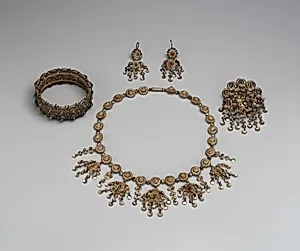
Bracelet
ca. 1873
Medium
Silver filigree
Classification
Metalwork-Silver
Culture
Norwegian, Christiania
Department
European Sculpture and Decorative Arts
Museum
Metropolitan Museum of Art, New York, NY
Credit
Gift of Mrs. Harriette M. Arnold, 1906
Accession Number
06.468
Rights
Public Domain
Art Historical Context
This exquisite silver filigree bracelet, crafted around 1873 by Jacob Ulrich Holfeldtostrup of Christiania (now Oslo), Norway, exemplifies the masterful metalwork traditions of 19th-century Scandinavia. Tostrup, from a renowned family of silversmiths who founded one of Norway's premier workshops in 1833, produced jewelry that blended delicate elegance with technical precision. Housed in the Metropolitan Museum of Art's Department of European Sculpture and Decorative Arts, it was generously gifted by Mrs. Harriette M. Arnold in 1906. The bracelet's medium—silver filigree—highlights an ancient technique revived in the Victorian era, where thin silver wires are twisted, looped, and soldered into intricate, lace-like patterns. This labor-intensive process creates a lightweight yet durable piece, often evoking floral or geometric motifs symbolic of nature's abundance, central to Norwegian design. Such work demanded exceptional skill, positioning Tostrup's output as a pinnacle of European decorative arts. In the context of Norway's burgeoning national identity during the 1870s—amid its union with Sweden—this bracelet reflects cultural pride in craftsmanship rooted in Viking-era metalworking traditions. It offers visitors a tangible glimpse into how everyday adornments became artistic statements of heritage and sophistication.