
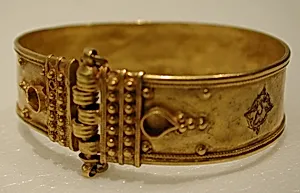
Bracelet
Unknown Artist
12th–13th century
Medium
Gold sheet with granulation
Classification
Jewelry
Department
Islamic Art
Museum
Metropolitan Museum of Art, New York, NY
Credit
Rogers Fund, 1952
Accession Number
52.32.1
Rights
Public Domain
Tags
Art Historical Context
This exquisite bracelet, crafted from a gold sheet adorned with granulation, hails from the Islamic world of the 12th–13th century. Dating to a vibrant era of medieval Islamic culture—spanning regions like the Abbasid Caliphate or early Mamluk domains—it exemplifies the unparalleled metalworking prowess of artisans whose identities remain anonymous. Acquired through the Rogers Fund in 1952, it now graces the Islamic Art department of the Metropolitan Museum Art, inviting visitors to marvel at its delicate form. The standout feature is granulation, a sophisticated technique where minuscule gold spheres (often just 0.1–0.5 mm in diameter) are precisely fused onto a gold surface without solder, creating a shimmering, textured mosaic. Revived from ancient Egyptian and Near Eastern traditions, this method demanded extraordinary skill and patience, highlighting the technical innovation of Islamic goldsmiths. Such bracelets were likely status symbols, worn by elites during celebrations or as protective talismans. In the broader context of Islamic jewelry, this piece underscores a cultural emphasis on geometric precision and luminous beauty, blending functionality with artistry. It reflects trade networks that spread these techniques across the Mediterranean and beyond, offering a tangible link to a golden age of craftsmanship.