
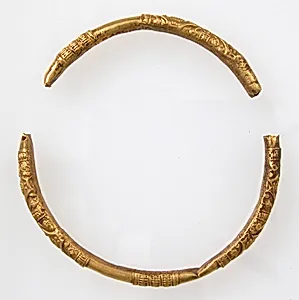
Bracelet
Unknown Artist
16th century
Medium
Gold
Dimensions
Overall (a): 4 1/2 x 3/16 in. (11.5 x 0.5 cm) Overall (b): 2 7/8 x 3/16 in. (7.3 x 0.5 cm)
Classification
Metalwork-Gold
Culture
Spanish
Department
Medieval Art
Museum
Metropolitan Museum of Art, New York, NY
Credit
Gift of J. Pierpont Morgan, 1917
Accession Number
17.190.154a, b
Rights
Public Domain
Art Historical Context
This exquisite 16th-century Spanish bracelet, now housed in the Metropolitan Museum Art's Medieval Art Department, exemplifies the opulent metalwork of Renaissance-era Spain Crafted from pure gold, it consists of two segments—measuring 4½ x ³⁄₁₆ inches (11.5 x 0.5 cm) and 2⅞ x ³⁄₁₆ inches (7.3 x 0.5 cm)—likely designed to clasp around the wrist with elegant simplicity. Though the artist remains unknown, the piece reflects the high level of goldsmithing skill prevalent in Spain during a time of immense wealth from New World explorations and the Habsburg monarchy's patronage of the arts. Gold's enduring allure as a medium symbolized wealth, status, and divine favor in Spanish culture, often adorning nobility and clergy. Techniques such as hammering, chasing, and possibly enameling (common in Iberian jewelry) would have produced its delicate form, balancing durability with intricate beauty. Worn during the Spanish Golden Age, such bracelets served not just as adornment but as heirlooms, conveying family prestige amid the era's religious fervor and artistic flourishing. A generous gift from J. Pierpont Morgan in 1917, this bracelet invites us to ponder the lives of its long-ago wearers—perhaps a lady of the court—bridging centuries with its timeless gleam.