
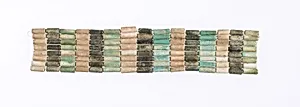
Bracelet
Unknown Artist
ca. 1802–1700 B.C.
Medium
Black, white and green faience
Dimensions
l. 16.4 cm (6 7/16 in)
Classification
Bracelet
Period
Middle Kingdom
Department
Egyptian Art
Museum
Metropolitan Museum of Art, New York, NY
Credit
Rogers Fund and Edward S. Harkness Gift, 1922
Accession Number
22.1.259
Rights
Public Domain
Art Historical Context
This delicate bracelet, crafted around 1802–1700 B.C. during Egypt's Middle Kingdom (Dynasty 13), exemplifies the era's masterful jewelry-making traditions. Measuring 16.4 cm in length, it fashioned from faience—a glazed ceramic composite of quartz, lime, and clay—in striking black, white, and hues. Faience was prized for mimicking semi-precious stones like turquoise or lapis lazuli, luxurious adornments accessible beyond the elite. In the Middle Kingdom, a time of renewed stability and artistic refinement after the chaotic First Intermediate Period, jewelry like this served both aesthetic and protective purposes. Worn on wrists or ankles, bracelets often symbolized status, fertility, or divine favor, with vibrant colors evoking the Nile's life-giving palette and the afterlife's eternal vibrancy. The use of multiple faience colors here highlights advanced glazing techniques, where copper salts produced greens and blacks, fired at low temperatures for a glossy sheen. Acquired through the Rogers Fund and Edward S. Harkness Gift in 1922, this piece now graces the Metropolitan Museum of Art's Egyptian Art collection. Imagine slipping it on, feeling the cool weight of millennia-old craftsmanship— a tangible link to ancient wearers who danced under the pharaohs' stars.