
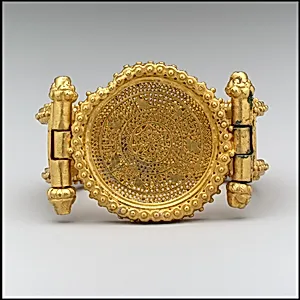
Bracelet (one of a pair)
Unknown Artist
ca. 400
Medium
Gold
Dimensions
2 11/16 × 2 5/16 × 1 13/16 in. (6.8 × 5.9 × 4.6 cm) Other (strap): 6 1/8 in. (15.5 cm) Other (weight): 0.4 lb. (0.2 kg)
Classification
Metalwork-Gold
Culture
Byzantine
Department
Medieval Art
Museum
Metropolitan Museum of Art, New York, NY
Credit
Gift of J. Pierpont Morgan, 1917
Accession Number
17.190.1668
Rights
Public Domain
Tags
Art Historical Context
This exquisite gold bracelet, one of a pair from around 400 AD, hails from the Byzantine world, a culture renowned for its opulent metalwork and enduring fusion of Roman grandeur with emerging Christian symbolism. Crafted solid gold—weighing a substantial 0.4 lb (0.2 kg)—it exemplifies the luxury reserved for the elite in the early Byzantine Empire, during the reign of emperors like Theodosius II. Measuring a compact 2 11/16 × 2 5/16 × 1 13/16 in. (6.8 × 5.9 × 4.6 cm), with a separate strap, it would have adorned the wrist with shimmering elegance, its surface likely adorned with doves, evoking peace, purity, and divine love in Christian iconography. As a prime example of Byzantine goldsmithing, this piece highlights advanced techniques in hammering, chasing, and possibly granulation, though the artist's identity remains unknown. Donated to the Metropolitan Museum of Art in 1917 by J. Pierpont Morgan, it bridges Late Antiquity and the Medieval era, offering a glimpse into daily adornment among Constantinople's nobility. The doves motif underscores the era's spiritual fervor, as Byzantium solidified Christianity as its cultural core, making this bracelet not just jewelry, but a wearable testament to faith and artistry.