
Bracelet
ca. 3300-2250 BCE
Classification
Jewelry and Ornament
Department
Smithsonian Collection
Museum
Smithsonian American Art Museum
Credit
Gift of Charles Lang Freer
Accession Number
F1917.386
Rights
Public Domain
Tags
About this artwork
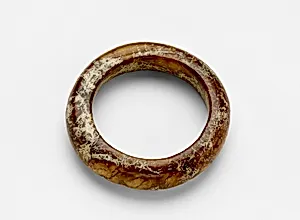
Bracelet, with slightly flattened sides and rounded outer surface; mottled yellow green, tan, and browns; sprinkled with milky white areas of incipient disintegration, more profuse in inner surface; proportions uneven; some tool marks on rim.
Art Historical Context
This exquisite bracelet, dating to approximately 3300-2250 BCE, hails from China's Late Neolithic period (ca. 5000-1700 BCE) and exemplifies the era's mastery of jade carving. Crafted from nephrite jade, a tough, resilient stone revered in ancient China for its durability and luminous quality, the piece features slightly flattened sides, a rounded outer surface, and mott hues of yellow-green, tan, and brown accented by milky white patches from natural disintegration—most evident on the inner surface. Uneven proportions and subtle tool marks on the rim reveal the hands-on craftsmanship of prehistoric artisans, likely using abrasive techniques to shape this adornment. Jade held profound cultural significance in Neolithic China, symbolizing purity, immortality, and elite status. Such bracelets were not mere jewelry but ritual objects, possibly worn in ceremonies or buried with the dead to invoke spiritual protection. This example, part of the renowned Charles Lang Freer collection and gifted to the Smithsonian American Art Museum, offers a rare glimpse into a time before written history, when nephrite from distant regions was arduously transported and transformed into treasures. Today, it invites us to marvel at humanity's enduring love for beauty in the everyday, bridging 5,000 years to touch our modern sensibilities.
About the Artist
Unknown
The artist designated as "Unknown" in our virtual museum's collection exemplifies a poignant chapter in art history: creators whose identities have faded into obscurity despite the enduring power of their work. With only one known artwork attributed to them in our holdings, this figure represents countless anonymous hands that shaped visual culture across centuries. Museums worldwide, including th...