
Bracelet
ca. 5000-1700 BCE
Classification
Jewelry and Ornament
Department
Smithsonian Collection
Museum
Smithsonian American Art Museum
Credit
Gift of Charles Lang Freer
Accession Number
F1917.387
Rights
Public Domain
Tags
About this artwork
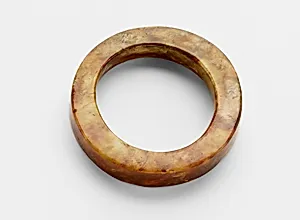
Narrow ring with wide perforation and flat sides, possibly a bracelet; mottled yellow, orange, and reddish brown; proportions irregular; some areas of gray incipient disintegration. (Rim slightly chipped.)
Art Historical Context
This delicate bracelet, crafted from nephrite jade during China's Late Neolithic period (ca 5000–1700 BCE), offers a glimpse into one of humanity's earliest mastery of hardstone carving. Appearing as a narrow ring with flat sides and a wide central perforation, it features mottled hues of yellow, orange, reddish brown, with irregular proportions that speak to ancient handcrafting techniques. Subtle signs of age—gray incipient disintegration and a slightly chipped rim—enhance its authenticity, evoking the passage of millennia. In Neolithic China, jade like nephrite held profound cultural and ritual significance, symbolizing purity, immortality, and connection to the spiritual world. Artisans used simple tools such as abrasives and bow drills to shape this exceptionally tough material, demonstrating remarkable skill for the era. Bracelets and similar ornaments were likely worn by elites or used in ceremonies, reflecting emerging social hierarchies in cultures like those of the Hongshan region. A generous gift from collector Charles Lang Freer, this piece graces the Smithsonian American Art Museum's collection, bridging ancient craftsmanship with modern appreciation. Visitors are invited to marvel at its enduring beauty and the ingenuity of its unseen creators.
About the Artist
Unknown
The artist designated as "Unknown" in our virtual museum's collection exemplifies a poignant chapter in art history: creators whose identities have faded into obscurity despite the enduring power of their work. With only one known artwork attributed to them in our holdings, this figure represents countless anonymous hands that shaped visual culture across centuries. Museums worldwide, including th...