
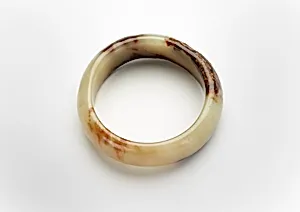
Bracelet
ca. 5000-2000 BCE
Classification
Jewelry and Ornament
Department
Smithsonian Collection
Museum
Smithsonian American Art Museum
Credit
Gift of Charles Lang Freer
Accession Number
F1917.388
Rights
Public Domain
Tags
About this artwork
Reportedly excavated in Shensi [1]
Art Historical Context
This elegant Neolithic bracelet, dating to around 5000–2000 BCE, hails from ancient China, reportedly excavated in Shensi (modern-day Shaanxi province). Crafted during the Neolithic period (ca 7000–1700 BCE), it exemplifies Chinese artistry when communities began mastering sophisticated stoneworking techniques. As part of the Smithsonian American Art Museum's collection, offers a glimpse into prehistoric life, where such ornaments likely held social, ritual, or status significance among agrarian societies. Carved from nephrite jade—a tough, translucent green stone revered in Chinese culture for its durability and symbolic purity—the bracelet showcases skilled lapidary work. Neolithic artisans prized jade for jewelry and ritual objects, often polishing it to a luminous sheen that evoked otherworldly qualities. Though the exact medium details are elusive, the carving technique highlights the era's technological prowess, achieved with basic tools like abrasives and strings. A gift from collector Charles Lang Freer, this piece joins his renowned trove of Chinese art at the Smithsonian, underscoring jade's enduring role in bridging China's ancient past to its imperial traditions. Visitors will appreciate its timeless beauty and the mysteries it whispers from millennia ago.
About the Artist
Unknown
The artist designated as "Unknown" in our virtual museum's collection exemplifies a poignant chapter in art history: creators whose identities have faded into obscurity despite the enduring power of their work. With only one known artwork attributed to them in our holdings, this figure represents countless anonymous hands that shaped visual culture across centuries. Museums worldwide, including th...