
Bracelet
ca. 3500-2700 BCE
Classification
Jewelry and Ornament
Department
Smithsonian Collection
Museum
Smithsonian American Art Museum
Credit
Gift of Charles Lang Freer
Accession Number
F1919.50
Rights
Public Domain
Tags
About this artwork
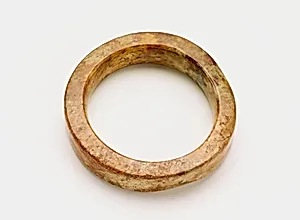
Narrow ring with wide perforation and flat sides, possibly a bracelet; mottled cream and golden tan with dark veinings; proportions irregular; three flattened areas on rims.
Art Historical Context
This delicate bracelet, dating around 3500-2700 BCE, hails from China's Late Neolithic period (ca. 5000-1700 BCE). Crafted from nephrite jade—a tough, prized stone revered for its luster and durability—it appears as a narrow ring with flat sides, a wide central perforation, and irregular proportions that hint at skilled hand-carving. Its mottled cream and golden tan hues, accented by dark veinings, along with three flattened areas on the rims, evoke the natural imperfections embraced by ancient artisans, transforming raw material into wearable art. In Neolithic China, jade ornaments like this were far more than jewelry; they symbolized status, spiritual power, and connections to the cosmos. Nephrite, sourced from distant riverbeds, required laborious grinding and polishing techniques, showcasing early mastery of lapidary arts. Bracelets often adorned the elite in burials, suggesting rituals tied to ancestors or the afterlife. A gift from collector Charles Lang Freer to the Smithsonian American Art Museum, this piece from the Freer collection bridges us to a time when jade's "imperial" green tones (here in warmer shades) laid the foundation for China's enduring jade tradition, influencing millennia of artistry.
About the Artist
Unknown
The artist designated as "Unknown" in our virtual museum's collection exemplifies a poignant chapter in art history: creators whose identities have faded into obscurity despite the enduring power of their work. With only one known artwork attributed to them in our holdings, this figure represents countless anonymous hands that shaped visual culture across centuries. Museums worldwide, including th...