
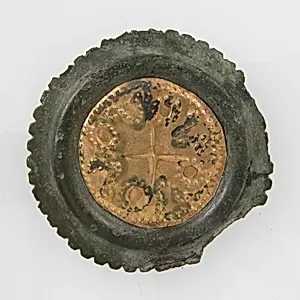
Bracteate
Unknown Artist
6th–7th century
Medium
Copper alloy, coated with gold
Dimensions
Overall: 1 9/16 x 1/16 in. (4 x 0.2 cm)
Classification
Metalwork-Copper alloy
Culture
Frankish
Department
Medieval Art
Museum
Metropolitan Museum of Art, New York, NY
Credit
Gift of J. Pierpont Morgan, 1917
Accession Number
17.192.68
Rights
Public Domain
Art Historical Context
Nestled in the Metropolitan Museum of Art's Medieval collection, this delicate *Bracteate* is a testament to Frankish craftsmanship from the 6th–7th. Crafted from copper alloy and coated with thin layer of gold, measures just 1 9/16 x 1/16 inches—small enough to wear as a pendant or brooch. Donated by J. Pierpont Morgan in1917, it exemplifies the exquisite metalwork of early medieval. Bracteates like this one were prized personal ornaments in Frankish society, a powerful Germanic kingdom that dominated much of western Europe after the fall of Rome. Often suspended from necklaces, they served both as jewelry and possible amulets, blending pagan traditions with emerging Christian influences. The Frankish Merovingian dynasty, known for its wealth and artistry, produced such items to display status and invoke protection. The technique of gilding copper alloy—mercury or fire-gilding—created a luxurious gold surface on a lightweight, affordable base, highlighting the ingenuity of ancient goldsmiths. This thin, single-sided disc, typically stamped with intricate motifs, reflects the Migration Period's fusion of Roman techniques and barbarian aesthetics, offering a glimpse into a transformative era of cultural exchange.