
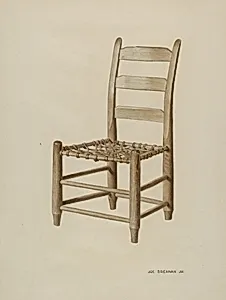
Braided Rawhide-bottomed Chair
c. 1939
Medium
watercolor, colored pencil, pen and ink on paper
Dimensions
overall: 30.6 x 22.8 cm (12 1/16 x 9 in.) Original IAD Object: 15"high; 19"wide; 13"deep; 35" to top of back.
Classification
Index of American Design
Department
CG-W
Museum
National Gallery of Art, Washington, D.C.
Credit
Index of American Design
Accession Number
1943.8.4423
Rights
Public Domain
Art Historical Context
Joe Brennan's *Braided Rawhide-bottom Chair* (c. 1939) is a meticulous rendering of a classic piece of American folk furniture, captured in watercolor, colored pencil,, and ink on paper (30.6 x 22.8 cm). This drawing faithfully reproduces the chair's sturdy form—originally 15 inches high, 19 inches wide,13 inches deep, with back rising to 35 inches—ing its woven rawhide seat and simple wooden frame. Such chairs evoke everyday craftsmanship from rural America, blending utility with regional aesthetics often seen in Southwestern or frontier designs. Created as part of the Index of American Design (IAD), a Federal Art Project under the Works Progress Administration during the Great Depression, Brennan's work preserves vanishing traditions of American decorative arts. The IAD commissioned artists nationwide to document folk objects through precise, colorful illustrations, fostering national pride in indigenous creativity amid economic hardship. This watercolor technique allowed for vibrant textures—the supple braiding of rawhide against warm wood grains—making the functional chair a celebrated artifact of cultural heritage. Today, housed in the National Gallery of Art's collection, it reminds visitors of America's handmade legacy, where everyday items like this chair embodied resilience and ingenuity. A testament to both Brennan's skilled draftsmanship and the era's artistic patriotism, it invites us to appreciate the artistry in the ordinary.