
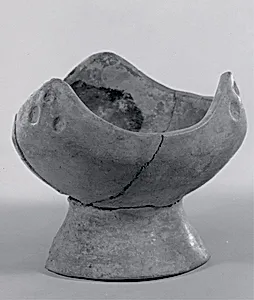
Brazier
Unknown Artist
ca. 9th century BCE
Medium
Ceramic
Dimensions
5 5/16 × 6 1/8 × 6 1/8 in. (13.5 × 15.5 × 15.5 cm)
Classification
Ceramics-Vessels
Culture & Period
Iran · Iron Age II, Hasanlu Period IV
Department
Ancient Near Eastern Art
Museum
Metropolitan Museum of Art, New York, NY
Credit
Purchase, The Adelaide Milton de Groot Fund, in memory of the de Groot and Hawley families, 1976
Accession Number
1976.233.15
Rights
Public Domain
Art Historical Context
This modest yet evocative ceramic brazier hails from ancient Iran during the Iron Age II, specifically the Hasanlu Period IV (ca. 9th century BCE). Measuring just over 5 inches tall and wide, it served a practical purpose: holding glowing coals for warmth, cooking, or rituals in everyday households. Crafted from fired clay, a durable medium well-suited to the region's arid climate, it reflects the sophisticated pottery traditions of northwest Iran, where sites like Hasanlu yielded treasures revealing vibrant local cultures. Unearthed from the ancient settlement of Hasanlu—destroyed around 800 BCE—this vessel offers a window into Iron Age life amid interactions between Iranian tribes, Urartians, and Assyrians. Its simple form underscores the ingenuity of anonymous artisans who shaped functional objects with everyday resilience, blending utility and subtle aesthetic appeal. As part of the Metropolitan Museum of Art's Ancient Near Eastern collection, acquired in 1976, it highlights how ordinary items illuminate the daily rhythms of a formative era, bridging the gap between archaeology and human stories long past.