
Bread Plate
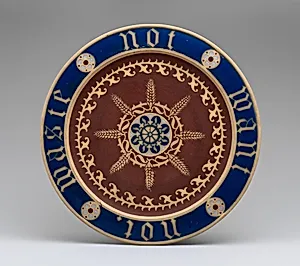
Medium
Earthenware
Dimensions
Diam. 13 in. (33 cm)
Classification
Bread plate
Culture
British (American market)
Department
The American Wing
Museum
Metropolitan Museum of Art, New York, NY
Credit
Friends of the American Wing Fund, 1986
Accession Number
1986.241
Rights
Public Domain
Art Historical Context
This elegant bread plate, crafted around 1850 by renowned Gothic Revival designer Augustus Welby Northmoreugin in collaboration with Minton and, exemplifies the mid-19th-century fusion of architectural grandeur and everyday utility. Measuring 13 inches in diameter, the earthenware piece was produced using durable, affordable clay fired at lower temperatures—a practical medium that allowed for intricate designs while suiting mass production. Pugin, a fervent advocate for medieval-inspired Gothic aesthetics amid Britain's Industrial Revolution, rejected neoclassicism in favor of ornate, moralistic motifs drawn from cathedrals and manuscripts. Working with Minton, a leading Staffordshire pottery firm famed for innovative glazes and shapes, he elevated tableware into art. Likely featuring Gothic tracery or heraldic elements (typical of Pugin's hand), this plate reflects his belief that beauty should permeate domestic life. Intended for the American market, it highlights transatlantic cultural exchange, as affluent U.S. households embraced British Gothic Revival for dining splendor. Acquired through the Friends of the American Wing Fund, it now graces The Metropolitan Museum of Art's American Wing, underscoring how imported ceramics shaped 19th-century American tastes and interiors.
About the Artist
Augustus Welby Northmore Pugin|Minton and Company · 1812–1852
Augustus Welby Northmore Pugin (1812–1852) was a British architect, designer, and theorist whose fervent advocacy for Gothic architecture transformed Victorian Britain's built environment and established the intellectual foundations of the Gothic Revival movement. Born in London to the French architect and draughtsman Auguste Charles Pugin, he showed exceptional talent from childhood, producing de...