
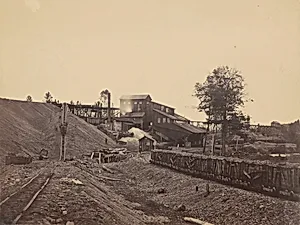
Breaker at Dickson, Del. & Hudson Canal Co.
c. 1863-1865
Medium
albumen print
Dimensions
image/sheet: 30.5 × 40.8 cm (12 × 16 1/16 in.) mount: 45.4 × 55.7 cm (17 7/8 × 21 15/16 in.)
Classification
Photograph
Department
CPH
Museum
National Gallery of Art, Washington, D.C.
Credit
Alfred H. Moses and Fern M. Schad Fund
Accession Number
2016.152.14
Rights
Public Domain
Art Historical Context
**Breaker at Dickson, Del. & Hudson Canal Co.** *Thomas H. Johnson, c. 1863–1865* Albumen print; image/sheet: 30.5 × 40.8 cm (12 × 16 1/16 in.); National Gallery of Art, Alfred H. Moses and Fern. Schad Fund during the Civil War era, Thomas H. Johnson's *Breaker at Dickson, Del. & Hudson Canal Co.* offers a stark glimpse into America's industrial backbone. The Delaware & Hudson Canal Company, a powerhouse in anthracite coal mining and transport from Pennsylvania's coalfields to eastern markets, relied on massive coal breakers like the one at Dickson—likely Dickson City—to crush and sort raw coal. This albumen print, produced from a glass negative coated in egg-white albumen for exceptional detail and rich tones, freezes a moment of gritty labor amid national turmoil, highlighting the unseen workers fueling the Union's war effort. Johnson, a pioneering photographer known for documenting infrastructure and wartime scenes, used the albumen process to achieve crisp clarity in large-format views, making this 12-by-16-inch image a vivid historical record. Printed on a generous mount, it invites viewers to ponder the human cost of industrialization: young "breaker boys" sorting coal in hazardous conditions, their toil powering canals and locomotives. As one of the earliest photographic tributes to America's coal heritage, this work bridges art and history, reminding us how 19th-century innovation rested on raw endurance.
About the Artist
Thomas H. Johnson · 1860–1870
Thomas H. Johnson was an American artist active in the latter half of the nineteenth century. Working during a period of considerable vitality in American art — when landscape painting, genre scenes, and printmaking were all flourishing — Johnson contributed to a visual culture that was expanding rapidly alongside the nation itself. The specifics of Johnson's training are not fully documented, th...