
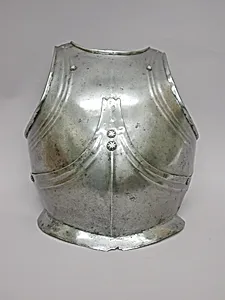
Breastplate
Unknown Artist
ca. 1480
Medium
Steel
Dimensions
H. 17 1/4 in. (43.8 cm); W. 14 1/2 in. (36.8 cm); D. 7 1/2 in. (19.1 cm); Wt. 5 lb. 12 oz. (2619 g)
Classification
Armor Parts-Breastplates
Culture
German
Department
Arms and Armor
Museum
Metropolitan Museum of Art, New York, NY
Credit
Bequest of George D. Pratt, 1935
Accession Number
48.149.32
Rights
Public Domain
Art Historical Context
This finely crafted German breastplate, dating to around 1480, exemplifies pinnacle of late medieval armor-making. Forged from steel, it measures 17¼ inches high, 14½ inches wide, and 7½ inches deep, weighing a substantial 5 pounds 12 ounces—practical yet protective for a knight in battle. As part of the Metropolitan Museum Art's Arms and Armor, bequeathed by George D. Pratt in 1935, it shielded the wearer's vital torso, curving ergonomically to deflect blows while allowing mobility. In 15th-century Germany, during the transition from chainmail to full plate armor, such breastplates represented advanced metallurgical skill. Artisans hammered and shaped the steel through riveting and polishing techniques, balancing strength with wearability. German armorers were renowned across Europe for their precision, producing pieces that combined functionality with subtle aesthetic appeal, often customized for tournaments or warfare. Imagine a armored rider charging into the fray—this breastplate evokes the chivalric world of the Holy Roman Empire, where protection was both art and survival. Its survival offers a tangible link to an era of feudal lords and emerging gunpowder threats.