
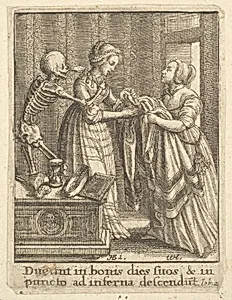
Bride, from the Dance of Death
[1651] late 18th century printing
Medium
Etching; second state of four
Dimensions
Sheet: 3 1/16 × 2 5/16 in. (7.7 × 5.8 cm)
Classification
Prints
Department
Drawings and Prints
Museum
Metropolitan Museum of Art, New York, NY
Credit
The Elisha Whittelsey Collection, The Elisha Whittelsey Fund, 1951
Accession Number
51.501.2132
Rights
Public Domain
Tags
Art Historical Context
In the haunting "Bride, from the Dance of Death," Hans Holbein the Younger’s iconic Renaissance design is brought to life through an exquisite etching by Wenceslaus Hollar. Created originally in the 1520s–30s amid Europe’s plagues and social upheavals, Holbein’s *Dance of Death* series—41 woodcuts in total—vividly illustrates Death’s impartial embrace, claiming souls from every station in life. Here, a skeletal figure interrupts a joyful bride on her wedding day, her lavish gown and floral crown contrasting sharply with mortality’s grim intruder, reminding viewers of life’s fragility. This second-state etching, printed in the late 18th century from a 1651 plate, showcases Hollar’s masterful technique as a 17th-century Bohemian engraver. Etching allowed for finer lines and tonal depth than Holbein’s original woodcuts, capturing intricate details like the bride’s delicate features and the skeleton’s bony menace in a compact 3 1/16 × 2 5/16 in. sheet. As part of the Metropolitan Museum of Art’s Elisha Whittelsey Collection, it highlights the enduring popularity of *memento mori* themes, blending moral allegory with Gothic horror to provoke reflection on vanity and eternity. A poignant snapshot of Northern Renaissance satire, this print invites us to dance with Death—however briefly.