
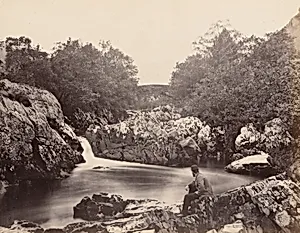
Bridge near Betws-y-Coed
c. 1858
Medium
albumen print
Dimensions
image: 19.5 × 24.9 cm (7 11/16 × 9 13/16 in.) mount: 38 × 55.6 cm (14 15/16 × 21 7/8 in.)
Classification
Photograph
Department
CPH
Museum
National Gallery of Art, Washington, D.C.
Credit
Purchased as the Gift of the Richard King Mellon Foundation
Accession Number
2018.7.13
Rights
Public Domain
Art Historical Context
Step into the lush landscapes of 19th-century Wales with Henry White's *Bridge near Betws-y-Co* (c. 1858), an evocative albumen print capturing the beauty of Snowdonia. Betws-y-Coed, a picturesque village nestled in the Conwy Valley, drew artists and photographers alike during the Victorian era for its dramatic bridges, rushing rivers, and misty hills—romantic motifs that echoed the era's fascination with nature's sublime power. White, a British photographer active in the 1850s, skillfully framed this stone bridge arching over a sparkling stream, inviting viewers to linger on the interplay of light and shadow amid verdant foliage. This work exemplifies the albumen print process, a groundbreaking technique introduced in the 1840s that coated paper with egg whites and silver salts for richly toned, highly detailed images. Popular through the 1890s, it allowed photographers like White to rival paintings in fidelity, bridging art and science. Measuring 19.5 × 24.9 cm on its mount, the print's crisp clarity highlights early photography's role in democratizing landscape imagery, once the domain of oil painters. Acquired by the National Gallery of Art through the Richard King Mellon Foundation, this piece from the CPH department underscores photography's swift rise as a collectible medium, preserving fleeting natural moments for generations of museum-goers.