
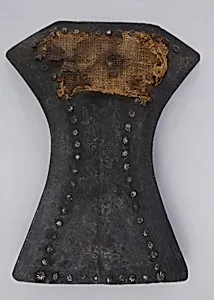
Brigandine Backplate
Unknown Artist
1400–1450
Medium
Steel, textile
Dimensions
H. 9 1/4 in. (23.5 cm); W. 7 in. (17.8 cm); Wt. 1 lb. 0.6 oz. (470.6 g)
Classification
Armor Parts
Culture
Italian
Department
Arms and Armor
Museum
Metropolitan Museum of Art, New York, NY
Credit
Bashford Dean Memorial Collection, Bequest of Bashford Dean, 1928
Accession Number
29.150.97
Rights
Public Domain
Art Historical Context
Welcome to the Arms and Armor gallery, where we uncover the ingenuity of medieval defense! This rare **Brigandine Backplate crafted in Italy between 1400 and1450, is a example of late medieval armor innovation. Made from steel plates riveted to a flexible textile backing, it formed part of a brigandine—a lightweight, garment-like armor worn by infantry soldiers and mercenaries during Italy's turbulent city-state wars. Its compact size (just 9¼ inches high and 7 inches wide) and featherlight weight (under 1 pound) highlight the shift from heavy plate armor to more agile protection, ideal for foot soldiers facing evolving battlefield threats like early firearms. The construction technique is both practical and artistic: small, overlapping steel plates were precisely riveted inside the fabric, allowing fluid movement while deflecting blows. This Italian piece reflects the Renaissance-era blend of functionality and craftsmanship, produced in workshops that catered to condottieri (mercenary captains) amid the era's political strife. Though the artist remains unknown, its survival speaks to the enduring legacy of these armors, now preserved through the Bashford Dean Memorial Collection at The Metropolitan Museum of Art (1928 bequest). Imagine a warrior slipping this into a doublet—protection without the bulk! A testament to human resilience and metallurgical skill.