
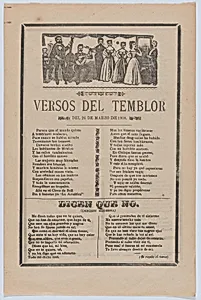
Broadsheet with songs relating to the earthquake that occurred on March 26, 1908
Medium
Type-metal engraving and letterpress on tan paper
Dimensions
Sheet: 11 13/16 × 7 7/8 in. (30 × 20 cm)
Classification
Prints
Department
Drawings and Prints
Museum
Metropolitan Museum of Art, New York, NY
Credit
The Elisha Whittelsey Collection, The Elisha Whittelsey Fund, 1946
Accession Number
46.46.471
Rights
Public Domain
Tags
Art Historical Context
This striking broadsheet, produced in 1908 by the prolific Mexican publisher Antonio Vanegas Arroyo and master engraver José Guadalupe Posada, captures public's response to a devastating earthquake on March 26 of that year. Printed using type-metal engraving and letter on modest tan paper (measuring just 11 13/16 × 7 7/8 in.), it features vivid imagery of men, women, and musicians with instruments, accompanying popular songs or *corridos* that likely mourned the tragedy and shared communal grief. Posada, a pioneer of Mexico's graphic arts, was renowned for his bold, satirical prints that commented on current events, blending folk traditions with social commentary. Broadsheets like this were affordable ephemera, sold on streets to disseminate news, ballads, and illustrations to the working class—making art accessible in an era before mass media. The technique of type-metal engraving allowed for sharp, reproducible details, perfect for capturing dynamic scenes of human resilience amid disaster. Housed in the Metropolitan Museum of Art's Drawings and Prints department (The Elisha Whittelsey Collection, 1946), this piece exemplifies early 20th-century Mexican popular culture, where art intertwined with music and storytelling to process calamity, offering visitors a tangible link to history's emotional pulse.